Showing posts with label pasolivo trip. Show all posts
Saturday, January 06, 2007
The day's collection
This was the fruit of our labor. :)
We picked more than the group of first graders that had toured and picked the day before, but less than an experienced set of pickers. (The ranch foreman had to send a set of pickers in after we left to really clear the trees.)
Buried in the tree
This is one of my fellow pickers wearing the bucket while pushing herself as far into the branches as she can to get her olives.
Friday, January 05, 2007
Collection bucket
This is the bucket into which most of the olives are picked during the harvest. It's usually worn with straps that hang over one's back so the bucket is always right in front of you like a baby in a sling. As the olives fall into it, regardless of how gently one tries, the olives hitting the bottom must bruise a little bit, so I'm wondering if they would be improved by cushioning the bottom or filling it with an inch or two of water.
Sunday, December 31, 2006
The group gathers and treks
This is the group I referred to in the previous post "Friday." I was about to spend the day with them and learn so much beyond just olives and olive oil, including:
- Gegenbauer makes a red pepper vinegar that is supposed to be amazing.
- Testament for a shop called "Le Sanctuaire" in Santa Monica, which after further investigation I see Food & Wine Magazine raving "No other shop in America offers such a remarkable mix of ingredients, cookbooks, equipment and high design or is such a magnet for innovative chefs."
- I learn about a chef/owner of a bakery who is best friends with the owner of Gegenbauer
- I hear about the forest district of Austria, Waldviertel, and that if I love great food I have to visit it
Why I really wanted to be there
I've read about olive oil and it's various methods of being processed. I had some idea what the smell of an olive mill might be (surprise, it smells a lot like olive oil). Seeing oil flowing into a barrel for the first time, though exciting, I could visualize in my head. But seeing an olive or an olive tree, or feeling the resistance of an olive as it's plucked (well, milked is the more proper colloquialism) from the tree, or smelling the soil and feeling the texture of an olive leaf--I didn't have any book education on that or any connection with that through my sensory exploration of the world's olive oils. Everything I had read said that most of the quality of an olive oil is determined by how well the olives and the olive trees are treated. No matter how carefully picked or how quickly pressed or how well cleaned the press, if the olive one puts in the mill hasn't been raised well, the resulting olive oil won't be stellar. I knew Pasolivo's oil was stellar, so I was excited to experience the grove with my hands and nose and eyes.
By the way, the colloquialism is milking because you treat the branch of the olive tree like a teat, pulling gently from the top and squeezing at just the right pressure as you pull down so that the fruit will pop off as you pull (as well as a few leaves and branches which mainly get separated out later). No beating, no shaking, no shimmying of the tree and branches. In the end, the olive branch is giving you it's milk and should be treated with the care and respect of a mother's teat in order to give the best that it can.
Saturday, December 30, 2006
Continuing the journey with Olive
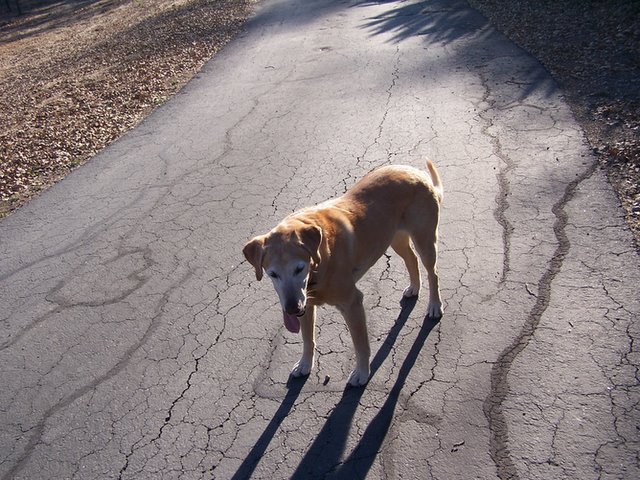
How many vineyards have dogs named Grape? Grape just doesn't seem like a good name for a dog... ahh, but Olive is a wonderful name for a dog on an olive ranch, and since she was my guide for my trip up the hill to take pictures of the ranch, I figure that she makes a good guide to start us onto our journey into the harvest of an olive.
Olive is fixated right now on a ratty old ball that every visitor to Willow Creek encounters when they get out of their car to walk into the tasting room. Olive will bound up, ball in mouth, seeking a new fetch companion--for Olive never (never!) grows tired of playing fetch.
Saturday, December 09, 2006
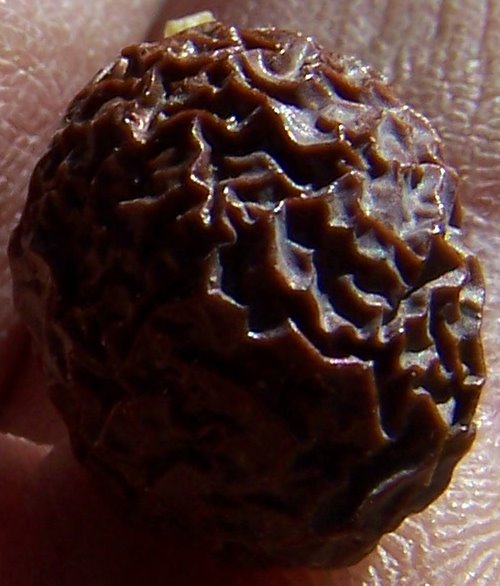
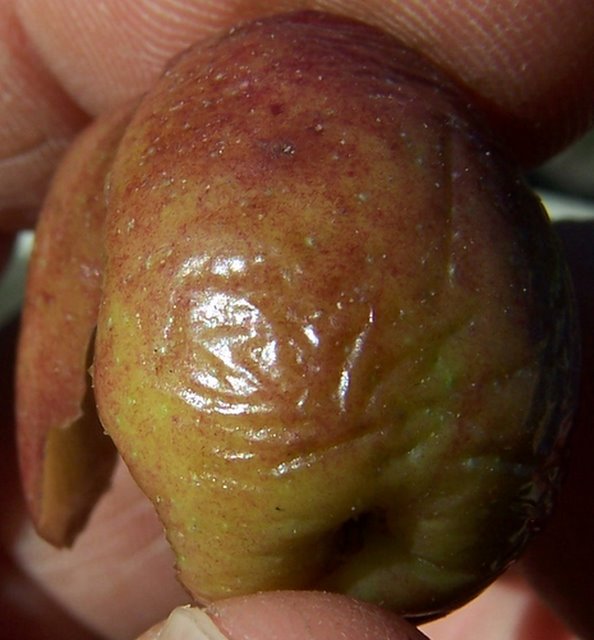
Miller's slang - monkeyface
Miller's slang - mummy
Mummy: a hard, shriveled olive that was missed during last year's harvest and remains on the tree
A mummy tends to attract birds to the fruit of the tree earlier than if no mummies were on the tree, and bird damage to the olives will cause bruising and wounds to the olives which will result in degradation of the flavor of the oil.
Thursday, December 07, 2006
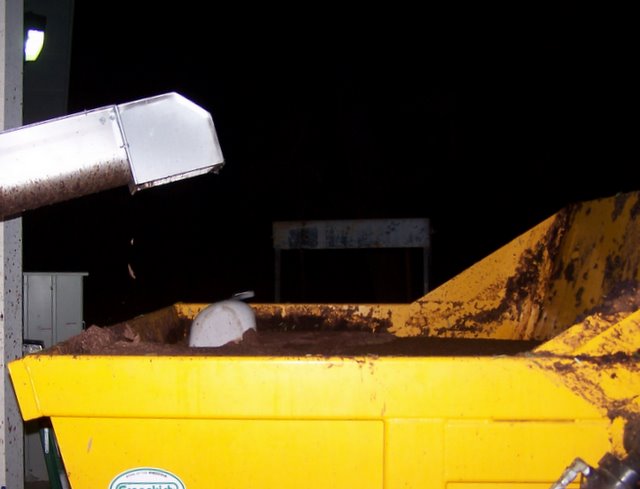
A double-fist of pomace
Getting pretty full
85% of the olive ends up here in the dumpster. If this was an industrial operation instead of a small, artisanal operation, then this could be processed even further to remove even more oil, through high heat or chemical processes which would leave edible, but not all that palatable olive oil. Regardless, there's a lot of pomace in an olive.
What about the waste?
And then we finally rest
Wednesday, December 06, 2006
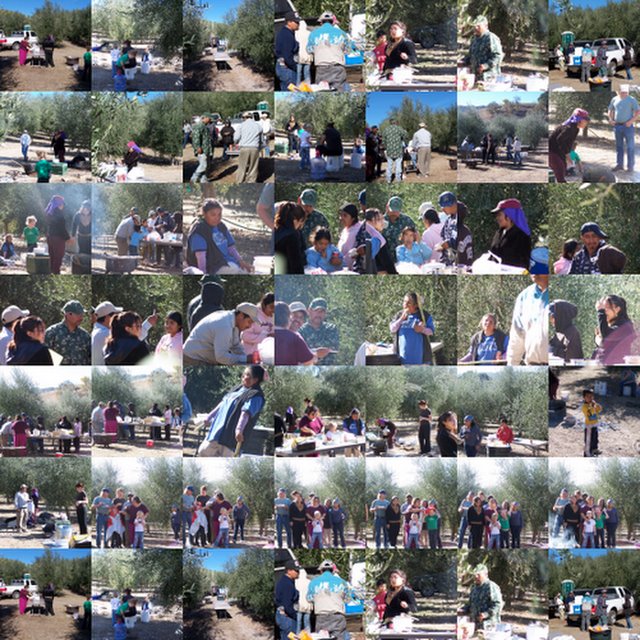
The end of the harvest celebrations

The end of the harvest brings lots of celebration. Everyone involved with olive oil knows how celebratory the creation and consumption of it is. This is the picker's harvest. Out of respect for their privacy, I present this in a collage. So from picker to miller to seller to consumer, it is appreciated by all. The only entity in the process that may not even consumer olive oil themselves is the distributor... so I'm tending to believe that the more barriers that exist between consumer and producer the less chance for quality in the product.
A few mixed short essays

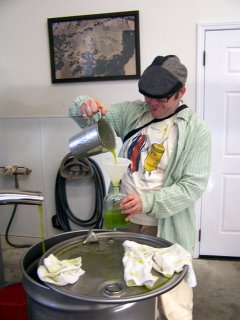
Me bottling the olive oil pressed from the olives I and a group of 17 others gathered in an hour and a half: 380 pounds.
The Bite
After waking up, breaking fast, and taking pictures, I discover an olive on the rocks near the milling equipment that had somehow hidden itself from Josh and Rich's eye during the hose down of the equipment. Unlucky olive. I had been waiting to bite into an uncured olive for... well, years. I crave to connect with food, and comprehensive knowledge wouldn't be comprehensive without trying everything.
After the bite, the level of astringency is what I find separates the taste of an untreated olive from the bitterness of a good olive oil, howver robust that oil may be. So many of the flavor components in that bitterness are water-soluble that if the water of the olive is still present, only unpleasantness will result. What I find so remarkable are the overlays of similarity; underneath all that nasty, the interesting flavors, notes, and sensations can be recognized. I can see why we as culinary machines were unwilling to leave the olive alone.
My next desire is to taste straight olive water--I wonder if it could be used like bitters? I wonder if I could sugar it up and let it ferment and what that would taste like?
Jovian Olive Oil Making
For the apron-bedecked Roman God Jove, sitting in his kitchen on Jupiter, making olive oil is easy. Wait for a hot day, smash a grove of olive trees in a mortar and pestle, let everything settle, pour the oil off of the top; it shouldn't take long.
If it's a cold day, you'll have a hard time getting olive oil out of a bottle, much less an olive, since olive oil will turn solid on a cold December Earth day. And on Earth the gravity isn't helping speed up the separation of the oil, water, and fruit solids. [Number One Rule when comprehending olive oil: Never forget an olive is just a fruit.] But I could toss all that mashed olive in a front loading dryer, turn it on for a while and then suck the oil out with a straw, because the dryer will apply enough centrifugal force with its spin to act like Jupiter's gravity (if you spin it fast enough). Add some bells and whistles to make it as efficient as possible at applying centrifugal force to mashed olives and Josh & Rich are as good as Roman gods in the kitchen.
Friday
After Robbie and Sarah and I woke up we had quick, light breakfasts of English muffins or toast (mine drizzled with the Orange Pasolivo from the night before--tasty). Our first task that day was to bring empty bottles to the mill in preparation for the Miller's Lunch that day. Joeli had two major events planned for the weekend. The one today was for about 16 people who had paid Willow Creek for the opportunity to pick olives, watch them go through the mill, and bottle and label for themselves 3 200 milliliter bottles of Olio Nuovo. If this sounds a little Tom Sawyeresque, painting fences for Joeli, Catalino & crew, keep in mind it also included a catered lunch of
appetizer: 3 cheeses (truffle cheese, la tur, abbaye de ????), walnuts, pistachios, dates, citrus fruit, turkey pate, and cookie thick flatbread.
soup: butternut squash drizzled with Lime Pasolivo
roasted brussels sprouts and cauliflower
shortribs on creamy polenta
apricot rustic italian pie
with an open scotch bar before the dessert.
About 10am the group had gathered and we trekked up to a part of the ranch with Mission and Manzanilla olives. Willow Creek has two blends of extra virgin olive oil: one blend is the signature Pasolivo blend with five Tuscan varietals plus a smidgen of Kalamata; the other is California Blend with Mission and Manzanilla. Both taste amazing. Friday was a hefty learning day for me, listening, taking photographs, and encountering my first olive trees.
Olive Oil 101.03
Olives and avocados (and a couple of other more obscure fruits to the American palate) are anomalies in the realm of culinary fruits. Instead of storing energy in the form of carbohydrates (sugars or starches), olives and avocados store it in the form of fats. You'll best understand what makes a good olive oil if you understand that nothing but containing oil separates an olive from a cherry or a peach or a plum. Take a handful of cherries, squeeze really hard, and you'll have water and sugar (in a water solution) in rivulets of red. In addition to that you'll have all those chemicals which make a cherry look like a cherry and taste like a cherry and an olive taste like an olive.
Tuesday, December 05, 2006
A little more fun
At the end
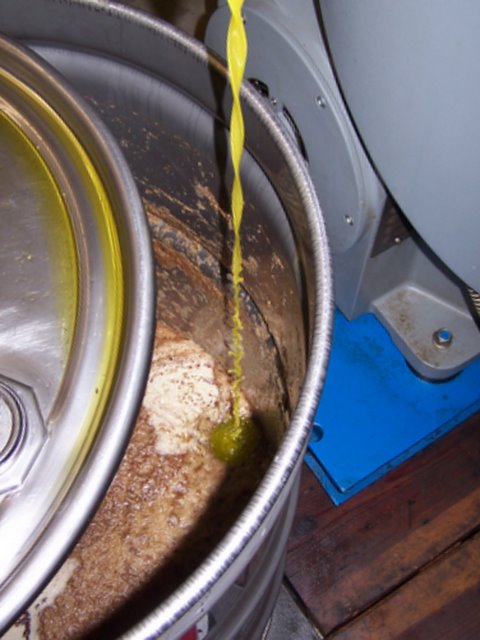
After those two centrifuges have their way with the mash, the end of the continuous process press is here. The result is being placed into a stainless steel barrel.
Tomorrow I'll show you the vats in which all of the oil is kept. Then, on to the waste from the first centrifuge, called pomace. The next batch of pictures will go further into the beginning, documenting the harvest of the olives from the trees.
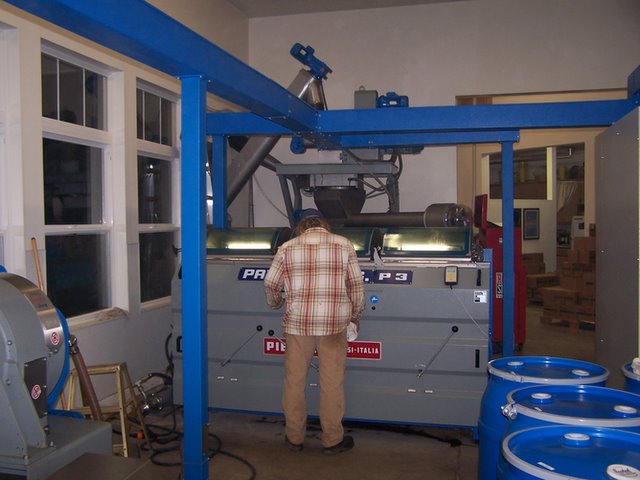
Everything behind me
That's Rich. He's watching the mill run, always at the ready to adjust or tweak with whatever needs it in order to respect the character of the oil.
To the left of the picture and behind me, there are two machines, both centrifuges. The first centrifuge is specifically made to separate olive oil from its mash, expelling the great quantity of waste product behind it and back outside. The second centrifuge is a more refined one, to decant more perfectly the final olive oil from its spigot.
Subscribe to:
Posts (Atom)